
Royal McGrady Ed-Tech recently led an official delegation to Uganda as part of our strategic partnership with the Uganda Institute of Information and Communications Technology (UICT). The visit marked an important milestone in the continued rollout of our jointly developed Augmented and Virtual Reality (AVR) Content Development Framework.

Presenting to the ICT Parliamentary Committee
A key highlight of the visit was the formal presentation and demonstration of the co-developed AVR course content to the ICT Parliamentary Committee. The session focused on how immersive, curriculum-aligned learning is being integrated into NCHE-approved diploma programmes, including Computer Science, Data Science and Management, Software Engineering, and E-Government & Digital Transformation.
The engagement showcased more than technology — it demonstrated a structured academic framework where immersive simulations are directly aligned to learning outcomes, assessment intent, and national skills priorities.
Alignment Workshop with UICT Lecturers
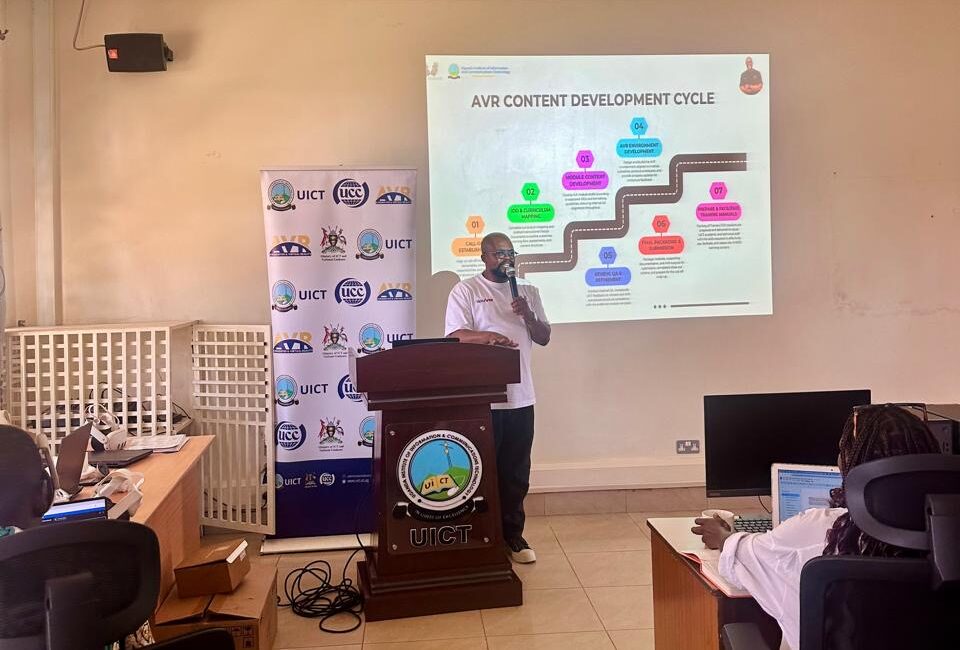
In addition to parliamentary engagements, we hosted a focused Alignment Workshop with UICT management and lecturers. The workshop unpacked the full AVR Content Development lifecycle — from curriculum mapping and Instructional Design Documents (IDDs), to module content development, simulation integration, quality assurance, and structured repository governance.
The objective was clear:
Strengthen institutional ownership
Improve development speed and consistency
Ensure academic compliance
Prepare for structured rollout and Training of Trainers (ToT)
By aligning academic, instructional, and technical teams, the workshop reinforced a disciplined and scalable approach to immersive course delivery.
Practical Integration of Advanced Technologies in the Classroom
At its core, this partnership is about the practical integration of advanced technologies at classroom level. AVR is not being introduced as an add-on or demonstration tool , it is being embedded into the teaching and learning architecture to improve learning outcomes.
Through immersive simulations, students are able to:
Engage in experiential, competency-based learning
Visualise complex ICT environments
Interact with real-world digital systems in structured scenarios
Develop industry-relevant skills within an academic framework
This approach is particularly important in environments where physical infrastructure constraints can limit access to specialised labs or advanced equipment. Education technology, when implemented correctly, becomes a powerful equaliser — bridging infrastructure gaps and expanding access to high-quality learning experiences.
Building Sustainable Digital Capability
Our collaboration with UICT reflects a shared commitment to strengthening Africa’s digital capability from within. By equipping lecturers, embedding structured development frameworks, and aligning immersive tools to national accreditation standards, we are supporting a model that is sustainable, scalable, and institution-led.
Access to quality, immersive education should not be a privilege. It should be a priority — deliberate in its design, aligned to national development goals, and accessible to every student.
The work in Uganda continues, and we remain committed to advancing immersive ICT education across the continent.
